
Your needs, this model
Does it fit your priorities?
Can I proof dough and make a 12-inch pizza indoors with the same oven?
Yes, as separate stages. Volt 2 has 70–100°F Dough Proofing and 12-inch pizza presets. Allow the cavity to reach the appropriate mode temperature between tasks.
Explore this need in the finder →Can I use the Neapolitan top Boost while holding dough at 90°F?
No. Top-element Boost requires the 710–850°F Neapolitan preset. The 70–100°F proofing range belongs to another mode.
Explore this need in the finder →Can I use this Volt outdoors because the earlier Volt 12 could?
No. Volt 2 is indoor-only. Choose the earlier USA Volt 12 for indoor/outdoor flexibility, or an appropriate outdoor gas model.
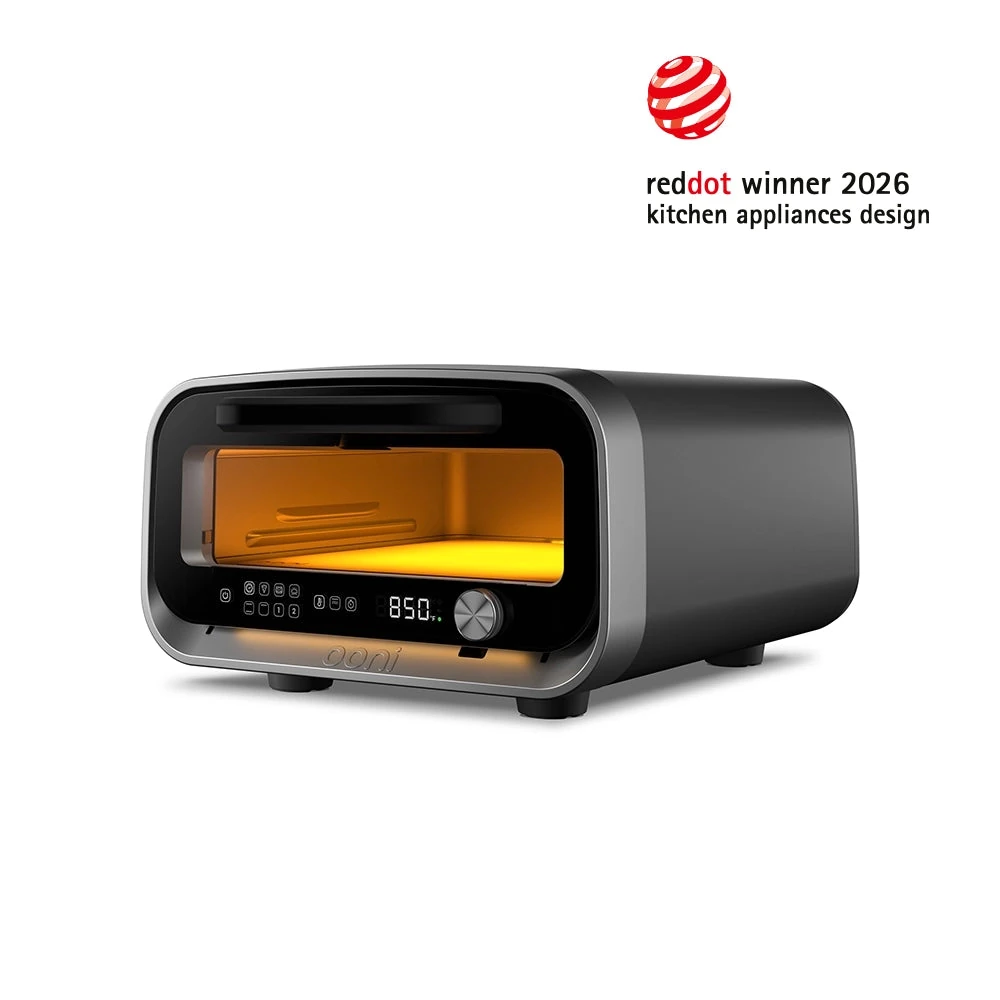
Explore this need in the finder →The Ooni Volt 2 is a good fit for a kitchen where pizza happens throughout the year and a propane cylinder or outdoor cooking station would be inconvenient. It uses a US 120-volt supply, has dedicated pizza presets, and also offers low-temperature dough proofing. Its appeal is the combination of a small pizza oven and useful lower-temperature modes, rather than the largest pizza you can buy.
Plan around one 12-inch pizza at a time. Ooni's current product page describes it as a 12-inch oven; the stone drawing measures approximately 13.23 inches square, while the launch announcement also mentions a 13-inch pizza. Those are not interchangeable promises of working room. A 12-inch round leaves more allowance for launching and turning. Anyone who routinely stretches larger pies should compare the outdoor Koda 2 Pro instead.
A smaller appliance still needs open space
The dimensioned drawing gives an overall width of 17.4 inches, depth of 21.46 inches and height of 10.35 inches. That is a useful starting point for measuring a countertop, but not the complete installation envelope. The manual requires at least four inches around all sides and six inches above, a stable heat-resistant surface, and room for the door and your peel. Storage in a cupboard does not mean cooking inside that cupboard.
The published unboxed weight is 38.8 pounds. Side handholds help with moving it, but remove the stone first and let the oven cool completely. Ooni expressly limits Volt 2 to indoor use. The earlier Volt 12 has different indoor/outdoor permission; its outdoor capability does not carry forward to this generation.
Check the US electrical version rather than importing a different plug configuration. The current US specification is 120V, 1600W with a North American Type B plug. The controls work at the oven. References to the Ooni app concern instructions, recipes and support, rather than permission to leave dinner unattended or operate the appliance through an external remote-control system.
Choose the pizza style before adjusting the heat
Pizza Intelligence manages heat using the oven's elements and sensors. You choose Neapolitan, Thin & Crispy or Pan Pizza, then refine the temperature, timer and available crisping setting. This reduces the number of starting decisions, but it does not launch, turn or remove the pizza. Keep watching the food through the large viewing window and adjust the bake to the dough and toppings.
The manual makes the boundaries concrete. Neapolitan defaults to 810°F and allows 710–850°F. Thin & Crispy defaults to 660°F within a 570–700°F range. Pan Pizza starts at 530°F and permits 450–560°F. A recipe calling for a different temperature may need another mode, rather than forcing the same preset beyond its adjustment range. Preset cooking times are starting points, not evidence that every pizza finishes at that moment.
Crisping intensity changes the emphasis on the top element. There are also two custom buttons for saving an adjusted preset, useful when the same dough and pan return every week. They bookmark settings; they do not measure the dough's moisture or establish that today's toppings are cooked.
Boost belongs specifically to the Neapolitan preset. Holding the dial starts a 30-second preparation sequence; wait for the ready indication before launching. The function strengthens the top element and becomes unavailable for three minutes after use. It is different from the earlier Volt 12's 45-second lower-element stone-recovery boost. Treat the matching name as a reason to read the correct instructions, rather than repeat an old routine.
Proofing and everyday cooking have their own limits
Dough Proofing adjusts from 70 to 100°F, with a 90°F default. It is useful when the kitchen is cool and you want a controlled environment for dough. It is not an active refrigerator, and the manual tells you to wait if the cavity is hotter than the selected mode. Proof first and then preheat for pizza, or allow cooling between the two tasks.
Oven mode covers 210–480°F. Broil uses an intensity setting instead of a selectable temperature and cooks with the door closed. The supplied shelf creates another position for suitable cookware and can serve as a cooling rack. These features make the Volt 2 more useful for smaller meals, but the shallow cavity still needs checking against your pan and food height.
Use approved pans or accessories for meat, vegetables and wet dishes. The manual prohibits meat or fatty foods above 480°F and reserves the stone's direct contact for pizza and other dry bread-based foods. A broad maximum-temperature specification is not permission to sear a fatty dinner at pizza heat.
The washable parts do not include the stone
The removable filter and oven shelf can go through a normal dishwasher cycle. The cordierite stone cannot: keep water, soap and chemical cleaners off it. Its prescribed cleaning cycle uses full heat for 45 minutes, followed by complete cooling and brushing away ash. Wipe the cooled interior after use and avoid pushing debris toward the lower element. The filter reduces buildup; it does not make the oven smoke-free or remove the need to clean grease.
Allow the powered standby cooling period of at least 30 minutes before switching off or disconnecting, then wait for full cooling before moving or cleaning. Choose Volt 2 for indoor 12-inch pizza, repeatable starting settings and dough proofing. Choose Volt 12 only when its earlier-model controls and indoor/outdoor flexibility are the attraction. For larger pies or two pizzas together, move to an appropriately sized outdoor oven and plan that station separately.
Key details at a glance
| Fuel versions | US 120V / 1600W electric; indoor only. |
|---|---|
| Maximum pizza on standard stationary floor | 12 in |
| 12-inch pizzas at once on standard floor | 1 |
| Published standard-oven weight | 38.8 lb |
| Temperature hub supplied with oven | No |
| Food probes supplied with oven | 0 |
| Motorized stone supplied in base package | No |
| Standard cordierite thickness | 10 mm |
| Manufacturer maximum temperature | 850 °F |
| Monitoring and controls | Local digital temperature display; Broil shows intensity. The app provides resources, rather than remote cooking. |
| Optional rotating setup | Stationary stone; turn and remove pizza yourself. |
| Space and measurement note | Overall 17.4 W × 21.46 D × 10.35 H in. Operation needs at least 4 in on all sides and 6 in above, plus door and peel room. |
| Stone care | Keep the stone dry. Filter and shelf can use a normal dishwasher cycle. Allow at least 30 minutes of powered standby cooling before disconnecting. |
| Cooking modes and limits | Three pizza presets, 70–100°F proofing, 210–480°F Oven and intensity-based Broil. Each mode has its own adjustment limits. |
| Boost routine | Top-element Boost only in Neapolitan: 30 seconds of preparation, then unavailable for 3 minutes after use. |
| US voltage | 120 V |
| Electrical input | 1600 W |
| Saved custom settings | 2 |
| Dedicated dough-proofing mode | Yes |
Use the exact model’s instructions for operating limits, supplied equipment and version differences.
Sources for this assessment
Find a setup for your pizza night.
Choose your fuel, pizza diameter and serving layout, then add turning and monitoring requirements.