
Your needs, this model
Does it fit your priorities?
Can the Home Slice make a 12-inch New York-style pizza indoors using electric heat?
Yes. The U.S. manuals for both finish SKUs show a New York preset, the product page lists a 12-inch pizza capacity, and the appliance is an indoor 120V electric oven. It is one pizza at a time.
Explore this need in the finder →Does this oven support an outdoor pizza station?
No. The exact U.S. manuals label it for indoor use and explicitly say not to use it outdoors; an outlet or weather cover does not change that restriction.
Explore this need in the finder →Can I choose a Detroit preset on its controls?
No Detroit style button appears in either manual. The five named buttons are Neapolitan, New York, Thin Crust, Pan Pizza and Frozen, alongside a separate Manual control. A cook can experiment manually, but that is not a Detroit preset.
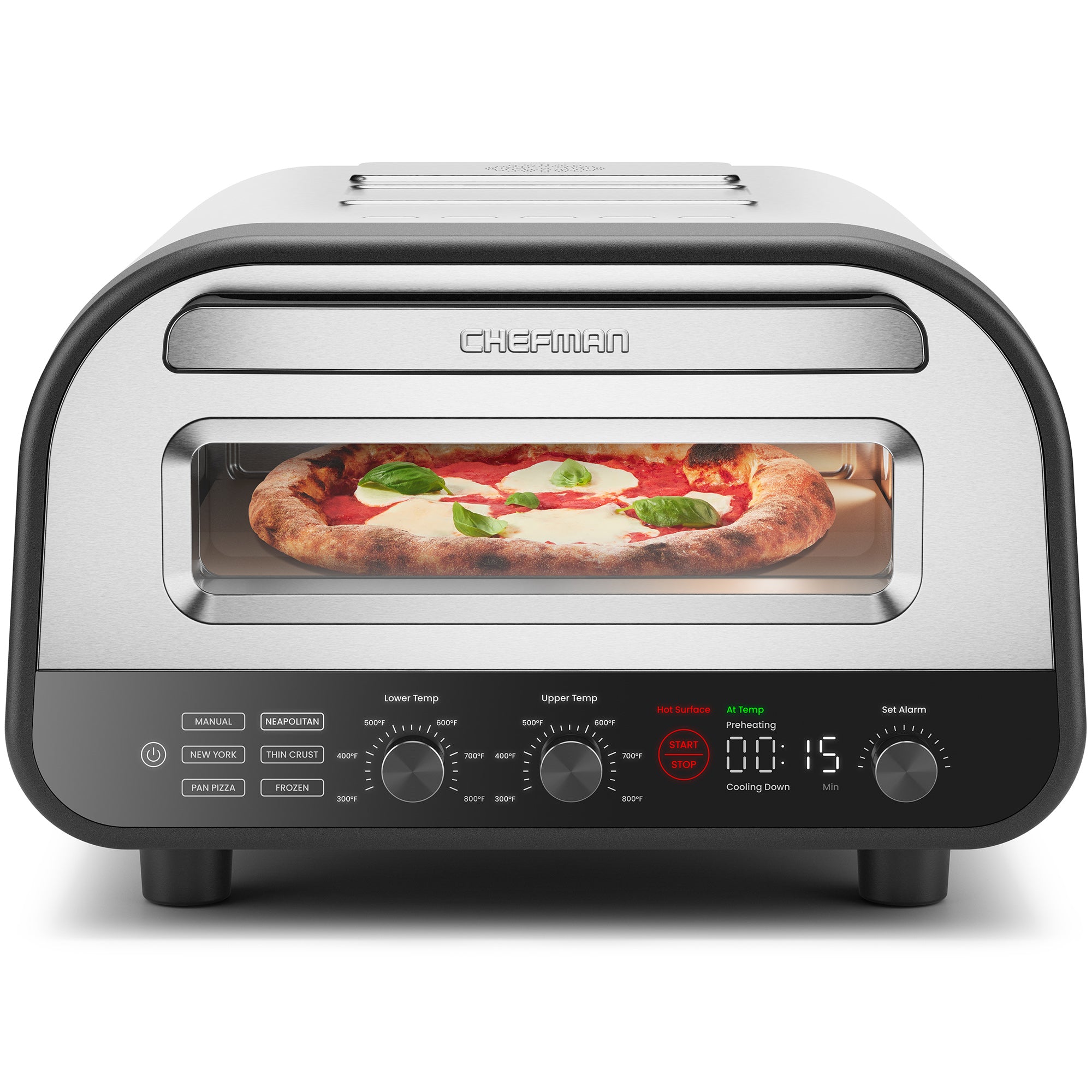
Explore this need in the finder →Chefman’s Home Slice RJ25-PO12 is a countertop electric pizza oven for a household that wants a dedicated pizza chamber without setting up gas or managing a live flame. Its stated limit is one pizza up to 12 inches. The stainless RJ25-PO12-SS and black RJ25-PO12-BLACK share the same documented cooking arrangement: indoor-only use, an included stone and peel, five named pizza-style buttons and manual upper/lower heat controls. It is a focused indoor appliance, not an all-purpose backyard oven.
Identify the exact finish before relying on a listing
Chefman lists the stainless and black finishes as separate U.S. native products with distinct SKUs, and its document library provides separate matching U.S. guides. I compared the two manuals: both show the same 12-inch capacity, 120V/1,700W listing, five style presets, manual mode, stone-and-peel arrangement and indoor-use restrictions. Their controls and use rules align, but text details differ; even the preheat estimates do. Match the guide to the oven label rather than assuming every listing detail transfers.
The black page contains a copied detail block that calls its model RJ25-PO12-SS and describes a stainless-steel body. Its title and native collection row say black, while the exact black manual cover says RJ25-PO12-BLACK. That conflict is worth noting if buying or identifying the unit: use the product label and its corresponding guide, not the inconsistent block.
Five pizza presets and manual upper/lower control
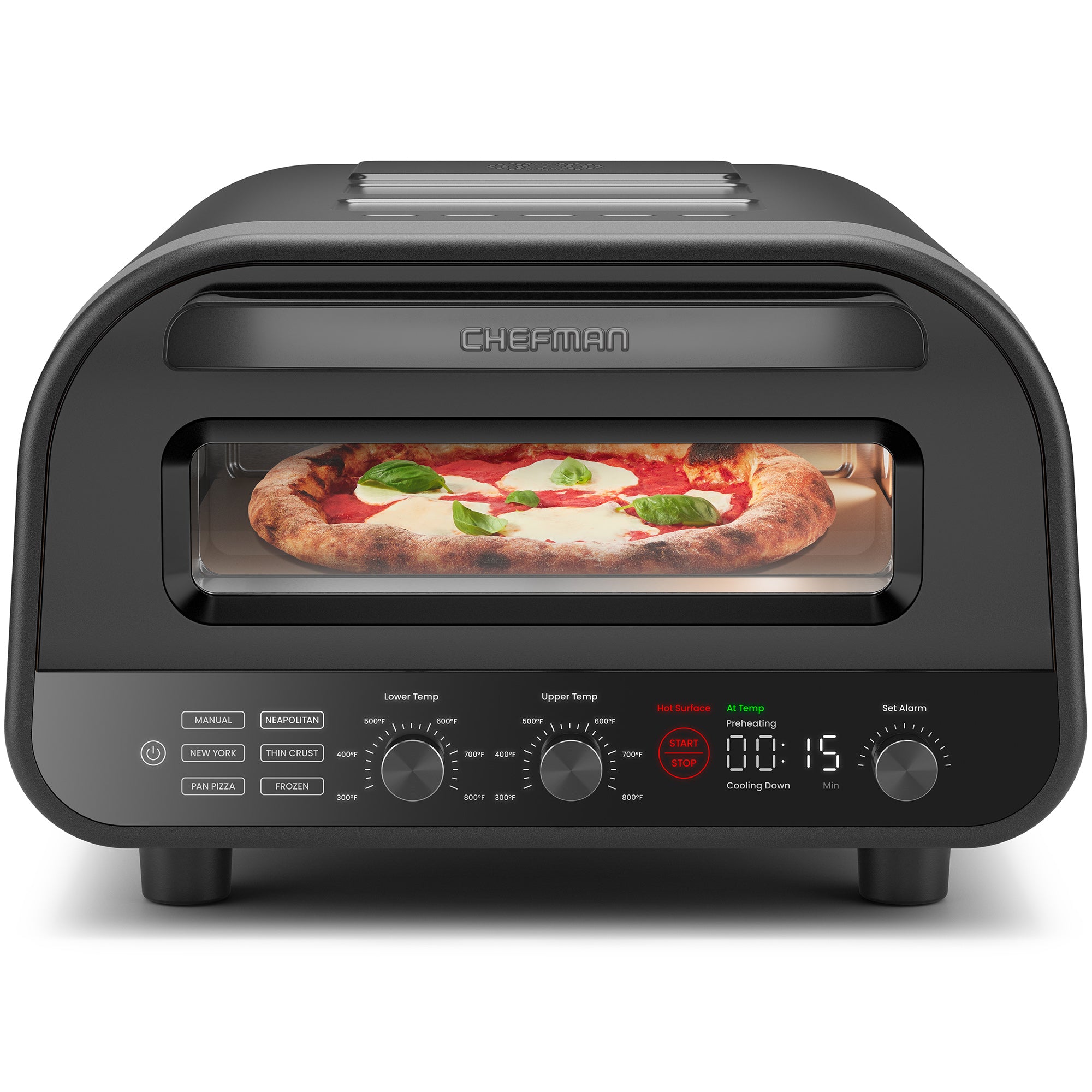
The five physical style buttons are Neapolitan, New York, Thin Crust, Pan Pizza and Frozen; Manual is a separate control. The U.S. guide’s suggested settings are:
- Neapolitan: 750°F lower / 750°F upper, 2½ minutes.
- New York: 650°F / 600°F, 5 minutes.
- Thin Crust: 700°F / 500°F, 7 minutes.
- Pan Pizza: 600°F / 475°F, 14 minutes.
- Frozen: 475°F / 450°F, 16 minutes.
Those are the maker’s reference temperatures and times, not test results or a guarantee for a particular dough. The manual says values can vary slightly from the unit. For manual cooking, the published range is 300–800°F, and the upper and lower settings cannot be more than 200°F apart. This allows a cook to adjust top and base heat, but it is not the same as controlling two left/right cooking zones.
Keep an eye on the timer and the next pizza
The oven includes its stone and peel. The double-paned viewing window and cool-touch handle are called out in the guides, but the illustrated control panel uses temperature knobs and an “At Temp” indicator rather than a numeric temperature readout (it does show preheat/alarm time). The exact manuals do not document a phone monitor, remote start, dedicated dough-proofing mode, Detroit preset, food probe or motorized turner. The stone is stationary, so launching, checking and turning remain hands-on.
The timer is an alarm, not a shutoff: Chefman’s manual explicitly says the heaters do not turn off when the timer ends. Treat its beep as a prompt to check the pizza, not unattended-cooking protection. Preheating depends on the set temperature and the oven’s current state; the black guide estimates 2–34 minutes and the stainless guide 1–26 minutes. Neither estimate guarantees a fixed heat-up time. The manual recommends about five minutes of recovery between pizzas.
Measure for indoor use, not outdoor entertaining
Both U.S. manuals say not to use the oven outdoors. An electrical plug, covered patio or outdoor outlet does not change that restriction. Chefman lists 120V and 1,700W, and the manuals require a grounded three-prong outlet. I found no numeric minimum circuit amperage in the reviewed material, so wattage should not be converted into a made-up manufacturer circuit rule.
The product page prints “18.7 in x 17 in x 10.94 in” without labeling which number is width, depth or height. It also lists 23.32 pounds without identifying an assembled carry weight. The manuals require adequate ventilation on all sides but give no numeric clearance. Those are important unknowns if space is tight or the oven needs frequent lifting: measure the unit and read its manual, rather than borrowing clearance or weight facts from a different electric oven.
Cleaning is part of the cooking routine
Do not run the oven without its stone. Once the unit has completed its powered cooldown and is cool, brush dry ash and residue away. The stone must not be wet, oiled or put in a dishwasher; the manual says it can be damaged by water and is sensitive to quick temperature changes. Flour and burned food can smoke or ignite at high heat. The manual describes a stone-only 800°F cleaning cycle for stubborn buildup; follow the exact guide and stay attentive. After turning the heaters off, let the cooling fan finish and wait until the Cooling Down light goes out before unplugging or moving the oven.
Who should compare alternatives?
Home Slice is worth considering if you want a dedicated indoor 12-inch oven with recognizable style presets and included launch tools. Look elsewhere if outdoor use, a larger pizza, simultaneous pies, remote monitoring or a preset that turns heat off are essential. The Current Model P+ is explicitly designed for indoor and outdoor use and lists app features and an interior light, but follow its separate electrical and placement instructions. The Ooni Volt 2 is an indoor-only alternative with a dedicated dough-proofing mode. These are different tradeoffs; each needs its own manual.
This assessment uses the two U.S. Chefman product pages, native collection identities, the document library and both exact U.S. manuals. It does not claim ownership or cooking trials. Read the SS product page, black product page, SS U.S. guide, BLACK U.S. guide and Chefman document library for the exact configuration.
Key details at a glance
| Fuel versions | Indoor-only electric appliance. Its U.S. product page lists 120V / 1700W. The U.S. manuals require a grounded three-prong outlet and prohibit outdoor use. |
|---|---|
| Maximum pizza on standard stationary floor | 12 in |
| 12-inch pizzas at once on standard floor | 1 |
| Published standard-oven weight | 23.32 lb |
| Temperature hub supplied with oven | No |
| Food probes supplied with oven | 0 |
| Motorized stone supplied in base package | No |
| Manufacturer maximum temperature | 800 °F |
| Monitoring and controls | Two temperature adjustment knobs, a numeric preheat/alarm time display and an At Temp indicator are illustrated; no numeric temperature readout is documented. Phone monitoring and remote startup are not documented in the reviewed exact U.S. sources. |
| Optional rotating setup | Stationary included stone; turn pizzas manually with the supplied peel. No motorized rotator is part of the reviewed oven. |
| Space and measurement note | Product listing publishes the unlabelled tuple 18.7 in × 17 in × 10.94 in. The reviewed page does not label those axes as width/depth/height; no orientation was assumed. Published 23.32 lb weight is not called a carried assembled-oven weight. |
| Stone care | Never operate without the supplied stone. Stone must stay dry, is not dishwasher-safe and must not be oiled. Cool fully, brush ash/debris, and follow the manual before using its 800°F/30-minute stone-cleaning cycle. Excess flour or burnt food can smoke or ignite. |
| Cooking modes and limits | Five physical pizza-style preset buttons—Neapolitan, New York, Thin Crust, Pan Pizza and Frozen—plus Manual control. The manual table lists element temperatures and recommended times; manual mode ranges 300–800°F and upper/lower settings must remain within 200°F of one another. |
| US voltage | 120 V |
| Electrical input | 1700 W |
| Dedicated dough-proofing mode | No |
Use the exact model’s instructions for operating limits, supplied equipment and version differences.
Sources for this assessment
Find a setup for your pizza night.
Choose your fuel, pizza diameter and serving layout, then add turning and monitoring requirements.