
Your needs, this model
Does it fit your priorities?
Does the exact CBO 750 Mobile page document its two-12-inch layout as a capacity guarantee?
The page illustrates two 12-inch pizzas together, but labels its layouts examples rather than capacity ratings. It is evidence for that layout, not an output-rate promise or a maximum size claim.
Explore this need in the finder →Can I choose an oven-and-cart package instead of arranging a separate stand or host appliance?
The CBO 750 Mobile page and specification sheet include the preassembled oven with a custom-built caster cart. It does not need a separate grill or stovetop, though the 750-lb weight and installation plan still matter.
Explore this need in the finder →Is the cart a light portable oven for frequent lifting or a three-10-inch layout documented?
No. The maker lists 750 lb for the oven with cart and does not document the requested three-10-inch simultaneous layout. Casters support the mobile-cart format, but ease of lifting or transport on any surface is not established.
Explore this need in the finder →Chicago Brick Oven · wood-fired mobile oven
Chicago Brick Oven CBO 750 Mobile review
A preassembled CBO 750 wood oven on its own heavy-duty-caster cart, with a large hearth and a placement plan that still deserves careful measuring.
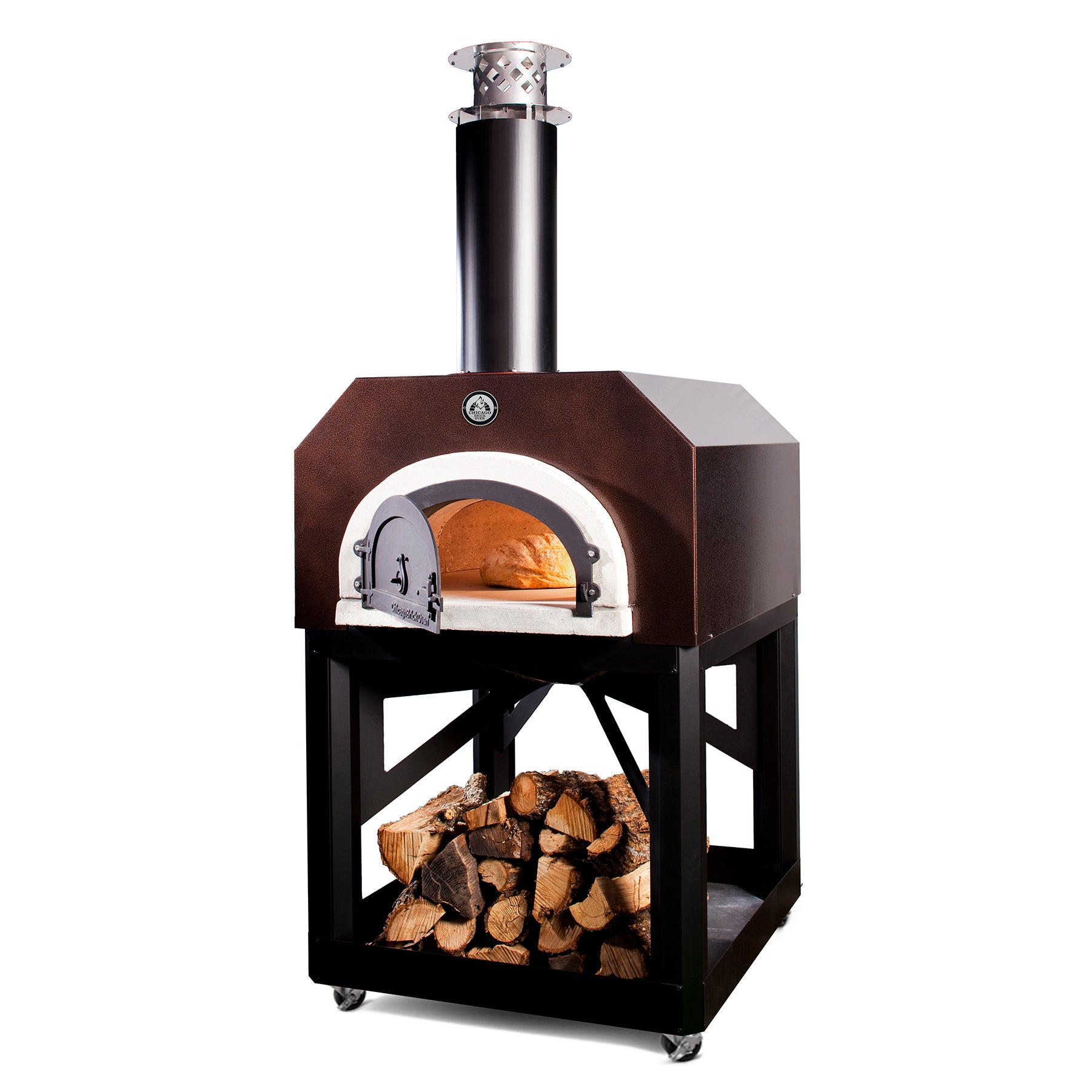
The CBO 750 Mobile is a complete wood-fired oven package arranged around the CBO 750 hearth, not just a wheeled stand or an oven shell intended for a masonry build. The exact U.S. product page describes the oven as preassembled and pairs it with a custom cart on heavy-duty casters. Its appeal is straightforward: bring the maker’s 38-by-28-inch cooking floor to a patio without designing a separate countertop or laying out a DIY oven kit. The tradeoff is that “mobile” describes the cart format, not a light appliance that one person can casually lift or load into a car.
What comes in this configuration
The manufacturer’s mobile specification sheet lists a preassembled oven, custom-built cart, metal insulating hood, and an accessory package with a pizza peel, cleaning brush, and infrared thermometer. The product page’s package description identifies the dome, three-piece hearth, arch, decorative door, insulation, chimney components, and cart. The sheet calls the oven-with-cart weight 750 pounds. That is a consequential placement detail: the casters can help reposition a unit on a suitable surface, but they do not make it a travel oven. Before ordering, measure the whole path to its location and confirm the surface, access, clearances, and any turning space with the dealer or installer. The listed weight is not a shipping weight or a lift rating.
The observed U.S. finish variants are Copper Vein (CBO-O-MBL-750-CV), Silver Vein (CBO-O-MBL-750-SV), and Solar Black (CBO-O-MBL-750-SB). They are finish choices under one product listing, not separate cooking systems. The current option selector and archived U.S. variant record show those three; the page body also mentions stainless steel without a corresponding variant in that record, so verify the exact finish if it matters to your order.
A roomy live-fire floor, not a capacity promise
CBO publishes a two-12-inch-pizza layout for its 750 cooking floor and explicitly labels its cookware and pizza drawings as examples rather than capacity ratings. That makes the illustration useful when you are planning a two-pie arrangement, but it is not a promise about hourly output or every dough and topping combination. The broad hearth also calls for active cooking: build and tend a wood fire, watch the food, and turn it by hand. There is no listed rotating stone, selectable pizza preset, phone monitor, or powered heat control. The included infrared thermometer is handheld; it is not an always-on temperature display or an automatic controller.
For matching, the maker’s illustration is evidence for a documented two-12-inch layout, not a maximum-pizza measurement. A request for an unshown three-10-inch arrangement should remain unanswered rather than be inferred from the hearth dimensions. Likewise, the product page’s marketing language about high heat is not an independent maximum-temperature test.
Installation and first use are part of the purchase
The current CBO wood-burning manual applies to the 500, 750, and 1000 wood models. It says to follow local permitting and inspection rules; its clearance page lists at least 10 inches at the sides and back, 18 inches above, and 30 inches below, plus 30 inches at each side of the doorway and 36 inches in front. It also gives a separate 7-inch separation for wood storage under an installation. Treat those as directional requirements, not one interchangeable distance: the complete manual, chimney plan, noncombustible enclosure details, and local code matter. For commercial indoor use the manual calls for ventilation meeting NFPA 96 or UL 710. Even though CBO lists indoor and outdoor certification, an indoor placement is an installation project, not simply a kitchen counter position.
Plan time for the initial cure before the first cook. The manual calls for slowly bringing the oven near 212°F without exceeding it, over two to three days, so remaining moisture can work out. It warns that a large first fire can damage the oven and says not to use chemicals or starter fluids. Wood firing also means smoke, ash, fuel handling, and hours-hot surfaces; this is not an effortless plug-in alternative to an electric countertop oven.
Who should consider it?
This is the clearest CBO fit for a buyer who wants the 750 size, a complete wood-fired package, and a cart rather than a separately planned supporting counter. It can also suit someone who values the option of repositioning an installed cooking station during a patio or landscape change, provided the route and floor can handle the substantial unit. Ask the dealer to confirm any required assembly, chimney extension, placement, and service details for your site.
Choose a different format if your priority is built-in architecture: the CBO 750 Countertop leaves its supporting base to the project, while the CBO 750 DIY Kit requires more installation and enclosure work. If a gas burner is essential, compare the distinct Hybrid-R product and its factory gas/altitude configuration rather than treating this wood-only mobile listing as convertible. If you need a light oven for frequent transport, automatic rotation, app controls, or a small first-cook learning curve, the CBO Mobile’s weight and live-fire routine work against that brief.
See the manufacturer’s CBO 750 Mobile listing, its mobile specification sheet, and the current CBO wood-oven manual before planning an installation. For a fixed-support alternative, compare our CBO 750 Countertop review; for factory-selected wood-and-gas operation, see the residential CBO 750 Hybrid DIY review.
Key details at a glance
| Fuel versions | This exact native product row has a wood-fired mobile model and three hood-finish variants. No gas burner, electric heating system or field conversion is listed. The 750 Hybrid-R is a separate product with separate gas/altitude variants and manual. |
|---|---|
| Maximum pizza on standard stationary floor | 12 in |
| 12-inch pizzas at once on standard floor | 2 |
| Published standard-oven weight | 750 lb |
| Motorized stone supplied in base package | No |
| Monitoring and controls | The mobile specification sheet includes a handheld infrared thermometer. It is not an integrated live temperature display, food probe, automatic controller or phone monitor. |
| Optional rotating setup | The exact product page and sheet list a stationary hearth and no powered turning drive. Plan to tend the wood fire and move food by hand. |
| Stone care | The current CBO wood manual says to raise the first fire slowly and cure near 212°F without exceeding it over two to three days. It warns against a large first fire and forbids chemical starters or starter fluid. |
| Cooking modes and limits | Manual wood-fired cooking only for this observed mobile product family; no gas or electric heater, digital preset or phone control is listed. |
| Saved custom settings | 0 |
| Dedicated dough-proofing mode | No |
Use the exact model’s instructions for operating limits, supplied equipment and version differences.
Sources for this assessment

Find a setup for your pizza night.
Choose your fuel, pizza diameter and serving layout, then add turning and monitoring requirements.