
Your needs, this model
Does it fit your priorities?
Can the earlier Dome handle one 16-inch pizza outdoors on its factory propane configuration while supplying the local display and two food probes?
Yes, on the exact factory propane variant, with the U.S./Canada manual’s placement and support requirements met; the oven itself is 128 lb and its support must hold at least 130 lb.
Explore this need in the finder →Can the earlier Dome be used indoors on a factory gas version when a qualified gas engineer and ventilation professional approve and install the setup?
The archived Gozney page and U.S./Canada manual describe indoor LPG or natural-gas use only with qualified installation and adequate, code-compliant ventilation. This is conditional, professionally designed indoor gas service, not a general kitchen/garage recommendation; the manual also warns against enclosed areas.
Explore this need in the finder →Can the original Dome satisfy a request for three 10-inch pizzas at once or indoor wood firing?
No. The original U.S. sheet documents one 16-inch pizza, not a three-10-inch layout, and its indoor exception is for gas with qualified ventilation. Wood is a separate outdoor routine.
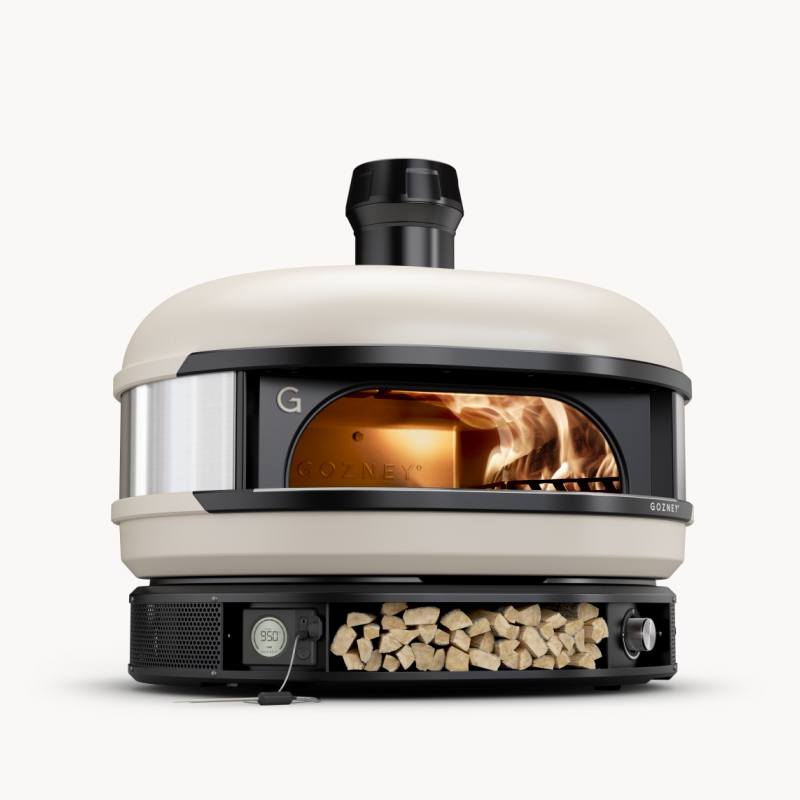
Explore this need in the finder →Gozney’s original Dome is an earlier model, not the Dome (Gen 2) now reached from Gozney’s old /products/dome address. Its U.S./Canada manual identifies model/type 4555-V1-02. A March 2025 archived copy of Gozney’s U.S. product page preserves the old native listing and four exact finish/fuel SKUs; that distinction matters when a retailer uses the shortened name “Dome.” The captured listing showed availability at that time only, not current stock.
Check the generation before comparing photos
The archived U.S. listing identifies native product 5226204627081 and four variants: Off Black propane (GDPOBUS1624), Off Black natural gas (GDNOBUS1625), Bone propane (GDPCMUS1239), and Olive propane (GDPOLUS1250). The Bone/propane image used here is exact to its variant. Gen 2 imagery and SKUs cannot stand in for these identities; ask a seller to confirm generation and fuel.
Gozney’s earlier product sheet documents one 16-inch pizza on the standard floor. It does not substantiate the newer model’s two-at-once 10-inch layout, and it gives no powered turning setup. So the safe matching picture is one 16-inch pizza, a stationary stone and hand-managed rotation; a request for three 10-inch pies together or a motorized stone should rule it out unless a separate exact compatibility source establishes otherwise. The product page gives a maximum above 950°F; that is a maker specification, not an independent measurement or a promise about a recipe’s result.
Gas and wood are separate routines
The Dome is described as a dual-fuel oven with distinct gas and wood operation, not a simultaneous gas-and-wood burner. The US/Canada manual lists a nominal 28,000 BTU per hour for both listed gas setups, at 11 inches water column for LPG and 7 inches for natural gas. Choose the factory gas identity that fits the installation; the manual is not a conversion guide. The natural-gas connection requires a qualified gas professional, correct pressure, leak testing and compliance with local rules. For wood, use the manual’s solid-fuel instructions instead; do not assume the current Gen 2 charcoal option also applies to this version. Pellets are not documented as a fuel.
Two food probes and the local digital thermometer console are listed in the original package. The console gives oven/stone-related readings and the probes measure food; neither means that a phone can monitor the oven or control its flame. Food probes are not stone thermometers. There is no documented automatic temperature control, pizza preset or motorized turner here. If you need supplied phone connectivity, remote gas adjustment, independent burner zones or a specific repeatable preset, this is a poor fit rather than a feature to infer from a screen or dial.
Location and support are part of the decision
For an outdoor station, use the later U.S./Canada manual as the controlling placement instruction: it specifies one foot at the rear and sides and three feet four inches in front from combustible construction, and says not to place the oven under or on top of a combustible structure. The older 2021 U.S. specification sheet prints different side/top figures; do not use its less-protective numbers to make a tight station appear to fit. The scalar clearance filter therefore uses the manual’s largest directional distance, 40 inches, while the detailed note preserves the directions. Gozney’s manual also calls for a level stable surface able to support 130 lb. Its archived product page lists the oven at 128 lb and 150 lb boxed; the separate support, fuel and any stand are not part of that oven-only figure.
The archived page allows indoor use only with gas and correct ventilation. The U.S./Canada manual’s indoor section requires qualified gas fitting, sufficient room ventilation, professional ventilation advice and local-code compliance, while also warning against enclosed areas. Treat this as a bespoke installation, not ordinary kitchen or garage permission. Wood is not an indoor plan; keep LPG cylinders outside enclosed areas. The page’s linked ventilation sheet is European reference material, not a U.S. CFM specification, so local professionals must determine the extraction design.
Who should choose the original?
This Dome suits someone who can dedicate a robust station, wants the documented 16-inch capacity, appreciates two included food probes and an oven-side console, and has a suitable outdoor propane, natural-gas or wood routine. Outdoor propane is the simplest plan if a correct tank location, connection, clearances and support are already available. Wood adds fire tending and ash handling; it does not remove the need for the oven’s substantial footprint or careful cool-down. Natural gas can avoid swapping a portable cylinder, but the factory natural-gas variant and a qualified gas installation are essential distinctions.
The current Dome Gen 2 is the first comparison for shoppers who want the newer product identity and Gozney’s stated larger cooking area; its own listing expressly describes one 16-inch or two 10-inch pizzas. The Dome XL Gen 2 documents a larger single-pizza class and three 10-inch layout, but is a still larger and heavier station. For one 16-inch propane pizza with less mass, compare Gozney Arc XL; it has a very different weight, fuel and probe setup. None of these comparisons makes the original’s installation clearances negotiable. Choose “earlier models” in the finder, then require the matching generation, fuel, pizza size, probe count, display and available clearance; if any essential answer is unknown, the model should not pass that condition.
This is a source-based assessment of the exact U.S. generation, not a report of ownership or cooking trials. Confirm the complete SKU, installation type and current manufacturer manual for the unit offered. Archived original Gozney Dome U.S. listing, Gozney Dome U.S./Canada manual DOC-0528-03, and Gozney Dome U.S. specification sheet, version 1.2.
Key details at a glance
| Fuel versions | Archived U.S. record lists Off Black propane GDPOBUS1624 / variant 43411296911497; Off Black natural gas GDNOBUS1625 / 43411296944265; Bone propane GDPCMUS1239 / 39308025135241; Olive propane GDPOLUS1250 / 40913967808649. The US/CA manual lists both LPG and NG at nominal 28,000 BTU/h, at 11 in. W.C. and 7 in. W.C. respectively, and discusses qualified indoor installations for either gas type. Factory fuel identity matters; this is not a conversion instruction. Wood is separate from gas, never simultaneous. Charcoal and pellets are not confirmed for this earlier exact model. |
|---|---|
| Maximum pizza on standard stationary floor | 16 in |
| Published standard-oven weight | 128 lb |
| Temperature hub supplied with oven | No |
| Food probes supplied with oven | 2 |
| Motorized stone supplied in base package | No |
| Manufacturer maximum temperature | 950 °F |
| Monitoring and controls | Archived original package lists the local digital display and two food probes. The console displays oven/stone-related readings; probes measure food, not stone. No included phone-monitoring or remote-flame-control system is documented. |
| Optional rotating setup | The documented floor is stationary. The reviewed U.S./Canada sources do not establish a powered rotating stone for the earlier Dome; turn and monitor food manually. |
| Space and measurement note | Archived official U.S. page gives 28.8 W x 24.8 D x 26 H in, oven-only weight 128 lb and 150 lb boxed. Manual says the level, stable supporting surface must hold 130 lb. A separate counter/stand and fuel are not included in the oven weight; their combined mass is not stated. Later DOC-0528-03 manual gives about 12 in at back/sides and 40 in in front from combustible construction and prohibits placement under/on a combustible structure. The older 2021 U.S. spec sheet lists different side/top figures; use the later manual, not the less-protective older numbers, for placement. |
| Stone care | Follow the matching U.S./Canada manual for gas fitting, ventilation, leak tests, clearances, supervised operation and gradual cooling. Do not use gas and wood together, operate in high winds or an enclosed/unventilated area, move the hot oven, wet the cooking stone, or use the oven as a room heater. Keep cylinders outdoors; clear ashes safely because they can remain hot after the oven cools. |
| Cooking modes and limits | The old U.S. product page claims temperatures in excess of 950°F; 950°F is recorded only as the maker’s published threshold, not an independently measured result. Its 2021 U.S. specification sheet confirms one 16-inch pizza. Simultaneous multiple-pizza capacity, temperature presets and motorized rotation remain unconfirmed for this generation. |
| Saved custom settings | 0 |
| Dedicated dough-proofing mode | No |
Use the exact model’s instructions for operating limits, supplied equipment and version differences.
Sources for this assessment

Find a setup for your pizza night.
Choose your fuel, pizza diameter and serving layout, then add turning and monitoring requirements.