
On this page
Your needs, this model
Does it fit your priorities?
Can the countertop Volta 90 meet the maker-listed three-12-inch need if I can handle up to 300 pounds?
Yes, its current product page claims up to three 12-inch pizzas. The floor geometry on the same page and drawing does not reconcile, so treat the capacity as a maker claim and confirm a specific layout if it is essential.
Explore this need in the finder →Can the Volta 90 meet an essential 13-inch individual pizza size?
No. The exact product page lists a 12-inch maximum pizza capacity. The conflicting floor-area figures do not establish a larger usable pizza size.
Explore this need in the finder →Can I get a ready-to-use natural-gas Volta 90 without a conversion purchase?
No. The U.S. page says the oven is propane-ready and requires a separate natural-gas conversion kit. Natural-gas compatibility is a separate setup, not a no-extra configuration.
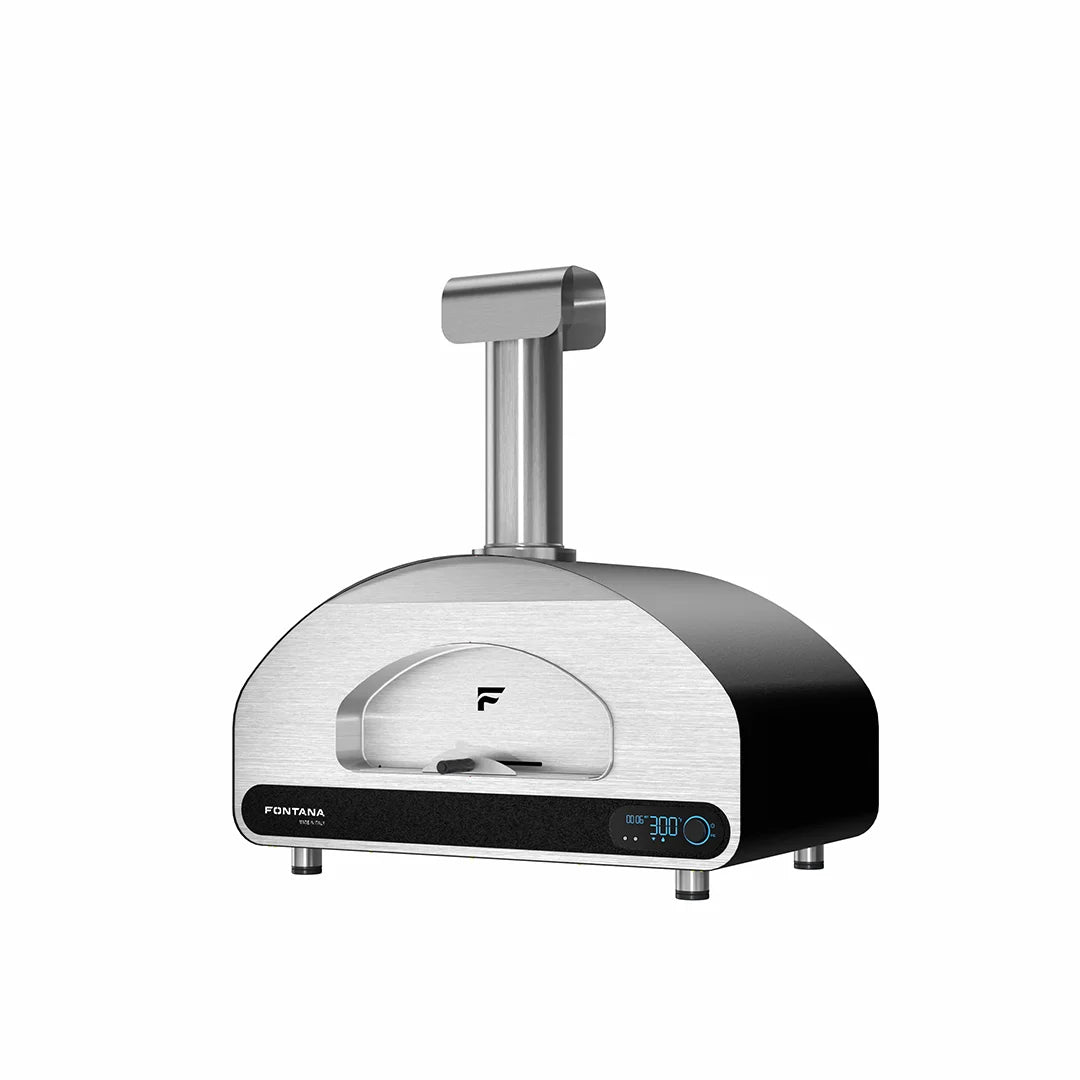
Explore this need in the finder →The Fontana Volta 90 is the larger of the company’s current smart gas ovens: a fixed outdoor appliance built around a wider cooking chamber, a front temperature display, two food probes, and phone-connected monitoring. Fontana advertises space for as many as three 12-inch pizzas at once, while the product’s default countertop configuration weighs 287 pounds before a cart, desk, gas cylinder, or site preparation. It is best considered for a permanent outdoor kitchen where serving several people and monitoring multiple cooks are real priorities—not as a backyard oven that moves easily because a cart can be added.
More room, but verify the published dimensions
The Volta 90’s clearest distinction from the 70 is capacity: the product page claims three 12-inch pizzas and lists a 672-square-inch surface in its specifications. However, that same page’s opening description calls the floor 31 by 20 inches, which calculates to a different area; its specification table instead says 28 by 24 inches. The technical drawing also presents a dimension set that does not reconcile neatly with both descriptions. I would not turn those conflicting numbers into a precise layout promise. The maker’s three-pizza statement is explicit, but it is still a manufacturer claim rather than a hands-on bake test. If fitting a particular pan, large pizza, or three-pizza arrangement is essential, confirm the usable floor dimensions with Fontana before ordering.
The product page also gives two burner ratings: 71,000 BTU in the lead description and 72,000 BTU in its specification list. That inconsistency does not change the core use case, but it is a reason not to compare the oven on a supposedly exact output figure. The countertop model is listed at 42.5 inches wide by 28.9 inches deep and 21 inches high, rising to 46.1 inches with the chimney. Its opening is listed as 20.1 inches wide by 8.1 inches high. Those dimensions, and its 287-pound listed countertop weight, deserve a real site and support plan before delivery.
Smart cooking without a light-duty footprint
The front-mounted digital module is intended to show oven temperature and probe readings. Two food probes and automatic target alerts extend the oven beyond pizza to roasting or longer cooks; the product page also describes Wi-Fi/Bluetooth and app monitoring. It says the oven can be switched off remotely, but the sources checked do not establish remote ignition or phone-start. Do not confuse monitoring and remote shutoff with starting a gas appliance from the app. The electronics use an external adapter; the manual specifies a 100–240V AC input and 12V DC output, while the cooking heat comes from gas or the documented hybrid arrangement.
The manual is important because the page’s “smart” description can make this look like a plug-in countertop appliance. It is an outdoor gas oven, not an indoor electric pizza machine. The manual says to use it outdoors only, to keep at least one inch from surfaces at the sides and rear, never to operate beneath overhead combustible construction, and to place the heavy oven on a flat fireproof support rated for its load. It also says to use a GFCI-enabled supply for the controls, check for gas leaks, keep the propane cylinder upright and no larger than 20 pounds, and avoid strong winds. Never move it while hot; the manual sets a cool-down point of 115°F before moving or storage.
Fuel, package, and warm-up caveats
The standard U.S. page lists propane as the stock gas, with natural gas requiring a separate conversion kit. The exact manual covers LPG and natural gas, but conversion is a different installation plan and the kit instructions matter; this is not a gas-line oven to connect casually. Fontana also markets wood use through a burner cover and wood holder listed in the box. The linked Volta manual is a gas-oven instruction book and does not give a complete wood-fire operating procedure in the reviewed material. If wood is the reason for choosing the Volta, get the current written wood-mode directions from the maker first; the matcher here does not treat that incomplete pathway as a verified fuel plan.
Fontana’s page says the oven can reach 750°F within 30 minutes or less and describes quick recovery. The manual’s more practical pizza instruction is to reach the target with the door closed and then wait at least 30–40 minutes before loading. It also requires a one-hour 660°F first-use burn-in. Those steps matter for a large oven with a long warm-up and an outdoor location exposed to weather. The manual recommends cooling, scraping and vacuuming the cooking floor, checking burner and venturi condition, and inspecting the hose; it warns that exterior metal can get hot. These are ownership tasks, not evidence that temperature recovery or bake consistency has been independently measured here.
Who benefits from stepping up
Choose Volta 90 over the 70 when its advertised three-pizza capacity and larger oven body solve a recurring group-cooking need, and your patio can take the mass, footprint, gas setup, and clearances. The 70 is the more restrained choice if two 12-inch pizzas are enough: it has a lower published countertop weight and narrower overall width, while retaining the smart module and twin probes. For a user whose priority is occasional, movable pizza nights, a smaller gas oven is more sensible than buying a 287-pound unit and relying on a cart. For indoor pizza, choose a specifically indoor electric appliance instead.
Do not choose the 90 for an exact floor-area or BTU threshold without written clarification: Fontana’s current product page disagrees with itself on both. The warranty is also inconsistent between the product page and linked manual. Ask for the current warranty and confirmed configuration for the exact U.S. finish/support SKU. The row groups several finishes and countertop, cart, and desk configurations; the weight above is for the countertop oven, not a complete cart/desk assembly. Confirm the chosen package, load capacity, installation clearances, gas arrangement, and current documentation before purchase.
Key details at a glance
| Maximum pizza on standard stationary floor | 12 in |
|---|---|
| 12-inch pizzas at once on standard floor | 3 |
| Published standard-oven weight | 287 lb |
| Food probes supplied with oven | 2 |
| Motorized stone supplied in base package | No |
| Manufacturer maximum temperature | 840 °F |
Use the exact model’s instructions for operating limits, supplied equipment and version differences.
Sources for this assessment
- Fontana USA current outdoor pizza oven product collection (exact native product and variant record)
- Fontana USA Volta 90 exact product page
- Fontana Volta 70 / Volta 90 domestic user manual, English/French, USA/Canada, Rev 1.012 (2025-11-21)
- Fontana Volta 90 technical drawing REV.01
- Fontana Volta natural-gas conversion instructions
- Fontana USA product-gallery image for Volta 90 Black countertop variant

Find a setup for your pizza night.
Choose your fuel, pizza diameter and serving layout, then add turning and monitoring requirements.