
On this page
Your needs, this model
Does it fit your priorities?
Can the Firenze be used on a household natural-gas line with the appropriate conversion?
Yes, after purchasing the model-appropriate conversion and having a licensed gas professional install and test it. The base propane setup is not the same as a ready natural-gas connection.
Explore this need in the finder →Does Firenze’s detailed specification support three 10-inch pizzas at once?
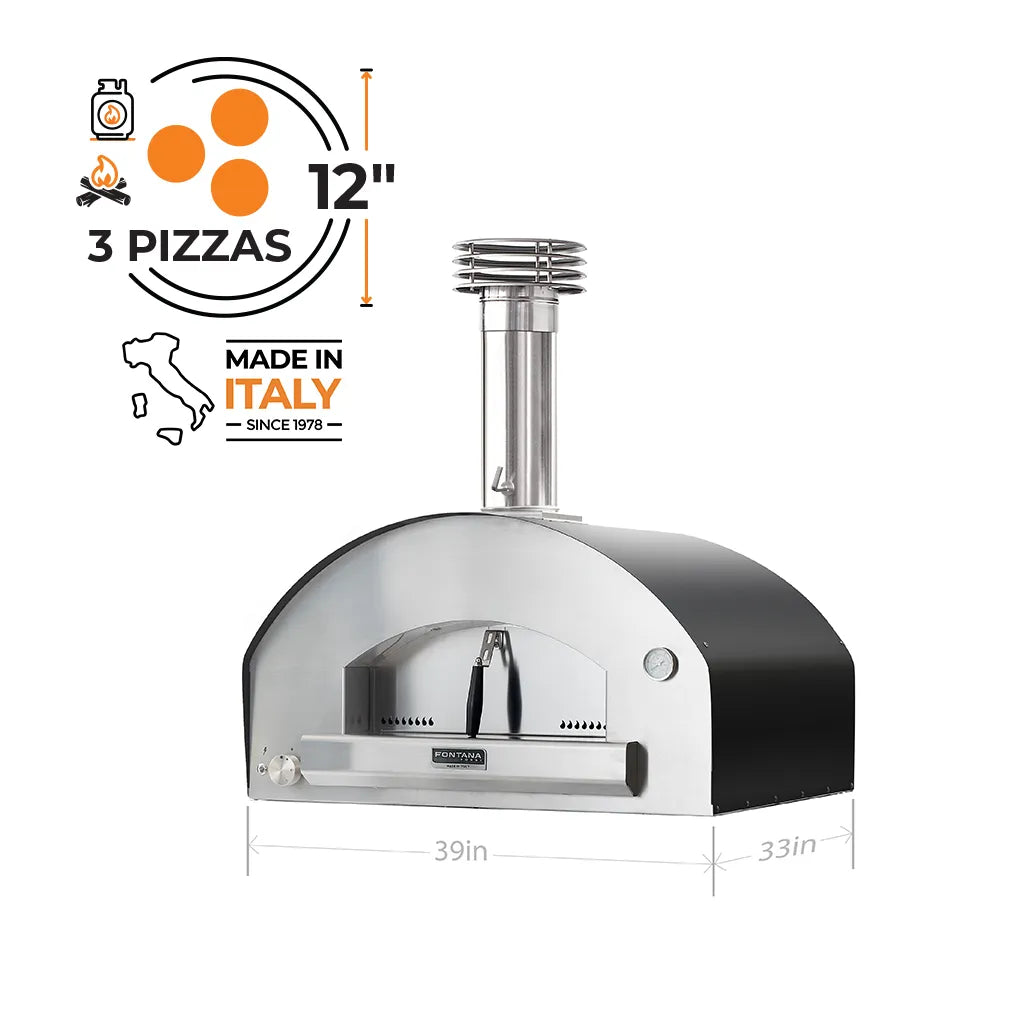
Yes. Its spec table lists three 10-inch pizzas. The same page’s graphic claims three 12-inch pies, but the detailed table lists two 12-inch plus one 10-inch instead, so three 12-inch capacity is not confirmed.
Explore this need in the finder →Can the Firenze be used in an open-air wood-fire plan?
Yes, using the included burner cover and wood holder as described in the hybrid manual. No roofed or indoor operation is confirmed.
Explore this need in the finder →Fontana Forni · outdoor hybrid
Fontana Firenze Hybrid Gas & Wood Oven
The New Gen Firenze gives a host a larger chamber than the Napoli and a choice between propane, converted natural gas and a wood fire. Its published three-12-inch claim conflicts with the specification table, so capacity should be judged conservatively.
What changes with Firenze
This is the New Gen Mangiafuoco hybrid, not the separate older Mangiafuoco wood-fired oven. The U.S. product row has 24 finish, support and stone configurations: gray, red or stainless; countertop, cart, desk or Elysia support; and standard or optional Saputo stone. That assortment lets you order a package for the installation you have, but it does not make the oven itself lightweight. Fontana lists 264 pounds for the countertop oven and 310 pounds with cart. Its outside dimensions are 33 inches deep, 39 wide and 26 high, or 47 inches to the chimney.
The listed cooking surface measures 24 by 28 inches, with a 24-by-32-inch interior. This gives the Firenze a useful middle position in the hybrid family: more room than the Napoli, less overall footprint than the Roma. Fontana’s exact listing describes two 12-inch pizzas plus one 10-inch pizza, or three 10-inch pizzas. Yet the same page’s introductory copy and its main gray model graphic say three 12-inch pizzas. Because those are materially different serving plans, the review does not treat three 12-inch capacity as established. A household that needs a dependable three-at-once pattern can plan around the listed three 10-inch layout; a two-12-plus-one-10 requirement is also listed. If three 12-inch pies are non-negotiable, confirm that precise layout with the manufacturer before purchase rather than relying on the banner image.
Hybrid fuel takes a little operating attention
Fontana rates the Firenze gas burner at 68,000 BTU and describes an estimated six hours from a 20-pound propane cylinder at full output. Those are manufacturer figures, not measured fuel use or a guarantee for every weather or cooking routine. The base gas supply is propane. Natural gas is available only after a model-appropriate conversion; the shared conversion sheet calls for a licensed plumber or gas technician, leak and pressure checks, and adherence to local codes. A natural-gas line is therefore a real installation requirement, not a fuel choice to assume is ready at delivery.
Wood operation is supported by the shared hybrid manual. To switch from gas, place the supplied stainless burner cover over the gas burner, then use the wood holder on the right side of the chamber and follow the wood-oven steps. To switch back, remove the wood holder and ash before taking away the burner cover. The two methods are alternatives in the same chamber, not simultaneous burners. That choice is valuable when you like predictable gas heat some nights and the attention of a wood fire on others. It is a poor fit if you want a sealed, unattended appliance or don’t want to store dry wood and remove ash.
The Firenze also differs from Napoli at the start button. Its manual’s model-specific quick-start guide says to prime the pilot by holding the knob for 1.5 to 2 minutes, press the igniter, hold for another 15 seconds for the thermocouple and then turn to the flame setting. The manual says to repeat that process if the oven has been sitting more than a day. Follow the current manual rather than assuming this pilot sequence is the same as the Napoli’s direct burner ignition. It is a practical setup detail, especially for a household that expects to turn the oven on for short, frequent sessions.
Installation and stone choices
The standard stone arrangement is included; Saputo is a separate option in the product selector. Fontana’s manual describes Saputo as a softer handmade stone that needs careful handling and gentle brushing while warm. Don’t select it just because a promotional claim promises a particular crust—the source does not provide independent cooking measurements. The package’s stone, color and support choice should be confirmed on the exact seller selection.
The manual says outdoor use only, prohibits operation under overhead roof construction or foliage, and requires at least one inch at the sides and rear. Without the supplied feet, it calls for a noncombustible support surface. Do not move the oven while hot; let it cool below 115°F first. These are not optional refinements to the maker’s “one-inch clearance” copy. The manual also states that the appliance is not intended for commercial use, which is why this assessment treats the Firenze as a household model, not a small restaurant oven.
Warranty information is inconsistent. The manufacturer’s page has a four-year dome statement in its warranty text and a ten-year dome/burner statement in its later product-spec block; the shared manual says four years on the dome. Confirm the written coverage for the purchased current U.S. configuration. Likewise, the three-12-inch serving graphic conflicts with the exact page’s smaller numerical table, so that capacity stays unavailable as a hard match.
Who should buy it?
The Firenze is for a household that wants meaningful batch capacity, a true gas-to-wood choice and has room for a large, permanently supported oven. It is more compelling than the Napoli when the three-10 or mixed 12-and-10 layout fits your gatherings. Choose the Napoli for a smaller footprint and its simpler direct ignition; choose the Roma when four 12-inch pizzas at once are the documented requirement and its larger 330-pound countertop or 385-pound cart configuration is manageable. Before choosing Firenze, verify the exact serving pattern, countertop load or cart placement, fuel conversion and written warranty. This is a source-grounded reading of Fontana’s current U.S. page and manuals, not a personal cooking test.
Primary references: Fontana Firenze product page, Firenze specifications, and the manufacturer manual library.
Key details at a glance
| Fuel versions | Exact current U.S. hybrid SKU family: stock LP/propane, natural gas after optional conversion, or wood using the included holder and burner cover. One mode at a time. |
|---|---|
| Maximum pizza on standard stationary floor | 12 in |
| 12-inch pizzas at once on standard floor | 2 |
| Motorized stone supplied in base package | No |
| Manufacturer maximum temperature | 900 °F |
| Space and measurement note | Dimensions are Fontana product/spec-page listings. The product-page body and its linked spec page are archived separately; areas/rounded intro claims are not treated as independent measurements. |
Use the exact model’s instructions for operating limits, supplied equipment and version differences.
Sources for this assessment
- Fontana U.S. outdoor oven native collection page 1
- Fontana Forni USA Fontana Firenze Hybrid Gas & Wood Oven exact current U.S. product page
- Fontana Forni USA Fontana Firenze Hybrid Gas & Wood Oven product specifications
- Fontana Hybrid Oven User Manual, revision 062024FFUSA2 (shared by Napoli, Firenze and Roma)
- Fontana Natural Gas Conversion Instructions, revision 10/26
- Fontana exact U.S. Fontana Firenze Hybrid Gas & Wood Oven product-page native gallery image position 1

Find a setup for your pizza night.
Choose your fuel, pizza diameter and serving layout, then add turning and monitoring requirements.