
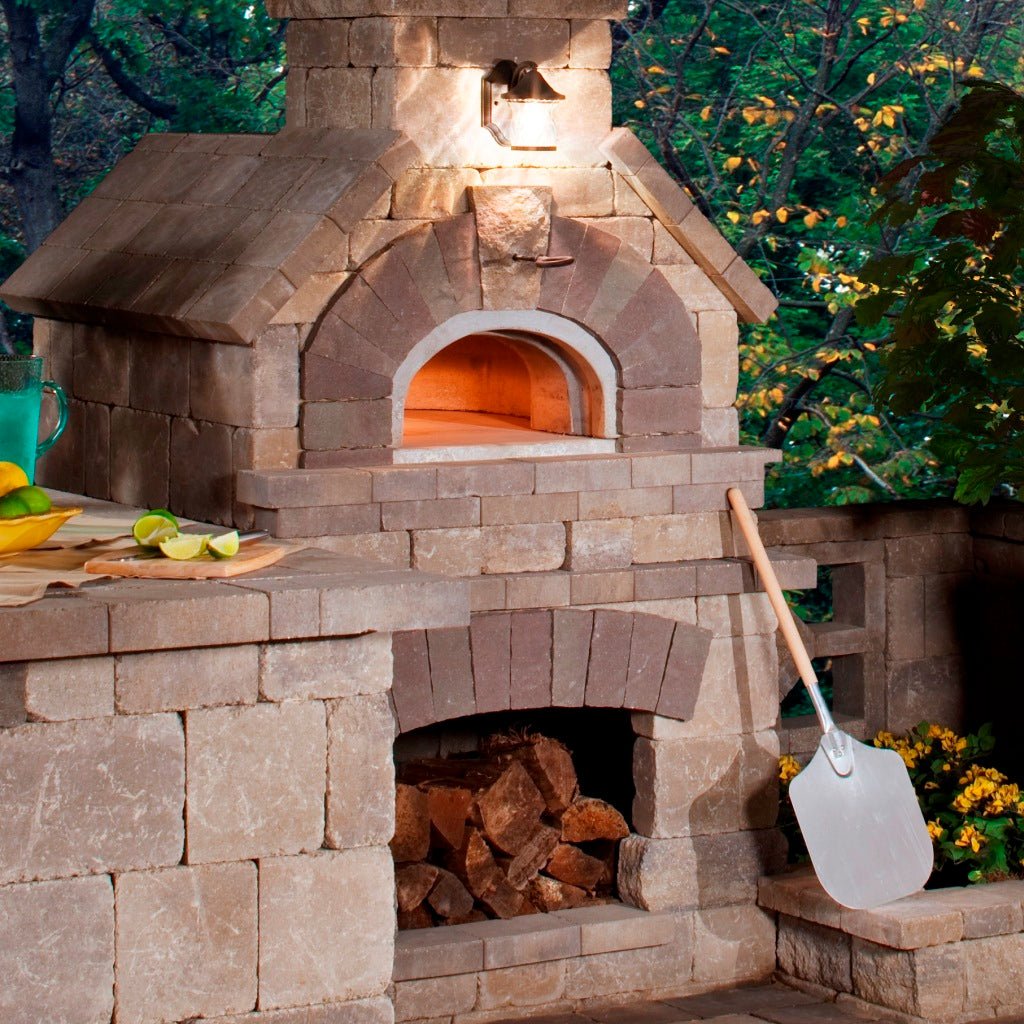
Your needs, this model
Does it fit your priorities?
Does the CBO 1000 DIY illustration document a two-12-inch-pizza serving request on its larger floor?
The page illustrates four 12-inch pizzas on the CBO 1000 but says layouts are examples, not maximum capacity. Two 12-inch pies are within that documented example; three 10-inch pieces are not established by the reviewed drawing.
Explore this need in the finder →Does the installed CBO 1000 fit the full documented combustible-clearance envelope when 36 inches is available?
The 1000 manual requires a 36-inch front-of-door zone and separate 4-inch side/back, 10-inch overhead, 30-inch below and 30-inch door-side spaces. The scalar matcher uses the largest direction only; full plans must follow all drawing dimensions.
Explore this need in the finder →Is the 920-pound CBO 1000 a match only for solid wood and a stationary hand-turning routine?
The exact native kit is wood fired; propane belongs to separately identified hybrid products. Its mass and fixed wood hearth do not create a gas configuration.
Explore this need in the finder →The CBO 1000 DIY kit is the largest wood-fired oven in this three-size family, and its 53-by-39-inch hearth changes the project as much as it changes the meal. Chicago Brick Oven’s current layout illustration shows four 12-inch pizzas at once and its product page describes more than 2,000 square inches of cooking area. The maker explicitly labels the layouts as examples, not maximum capacity, so four 12-inch pies are a documented arrangement—not a guaranteed upper throughput or a promise about every dough, pan or placement. The 21-inch opening also does not prove that every pizza near that diameter fits inside the chamber.
A large oven means a serious supporting structure
The package contains a seven-piece oven: two dome pieces, three hearth pieces, an arch and a removable insulating door. The listed install kit includes an anchor plate, insulating board and blanket, a steel plate and mortar; the accessory package lists a brush, infrared thermometer gun and pizza peel. The manual gives the oven weight as 920 pounds and says its support base must carry that oven plus the decorative cover you choose. The specification sheet separately lists dome, hearth and arch piece weights; those figures are useful for receiving and handling discussions, but I do not add them into a second carrying-weight claim. Neither number is the mass of the finished island, chimney and surrounding construction.
The supporting base, masonry finish and installation labor are not part of the oven package. The manual calls for installation by a professional or suitably qualified individual and a level, strong masonry or metal support. Before buying, have the installer work from the exact CBO 1000 drawings, the planned enclosure and local building/fire requirements. The 920-pound support minimum and the supplied anchor/chimney components do not make the structure or the rest of a compliant venting route appear by themselves.
Its clearance chart is different from the smaller ovens
The current wood-burning manual sets the 1000 apart from the 500 and 750. Around the oven, it calls for at least 4 inches at the sides and back, 10 inches above and 30 inches below. Around the door, it calls for 30 inches on either side and 36 inches in front; it also calls for 7 inches between the bottom insulation boards and any wood storage beneath. Those measurements protect different surfaces and are not interchangeable. The finder uses 36 inches—the largest directional clearance—as a conservative summary, but a construction plan must follow the complete CBO 1000 drawing and local code.
Although a current product heading uses the word “commercial,” the same manufacturer page expressly lists this kit for residential and commercial use. It belongs in a household catalogue on its exact residential-compatible evidence, rather than being excluded based on size or that one heading. The manual discusses both outdoor and indoor installations, subject to required clearances, chimney specifications and local authority approval. Indoor operation is only a potential professionally planned installation, not an ordinary kitchen-counter use or an assurance that an existing hood will suffice. The manual’s commercial indoor section cites NFPA 96 or UL 710 ventilation requirements.
Wood fire is a process, not a preset
This exact native model is a wood-burning kit. It is not the separate hybrid 750 and has no gas plan in the reviewed SKU. The manual permits solid, dry wood only and warns against scrap wood, compressed logs, coal and starter fluids. Its first cure takes two to three days near 212°F without exceeding that temperature; a damp or long-unused oven should be re-cured. Build heat gradually rather than starting with a large fire, and plan for the regular work of feeding fuel, moving food and clearing ash.
The maker’s diagrams show one 12-inch pizza per position, but no automated rotation, selectable temperature modes, food probes or phone controls are documented for this kit. The included infrared gun gives a manual surface reading; it does not hold a target or watch the food. The 1000’s special convenience is instead the removable insulating door in the package. The manual allows closed-door cooking only below 400°F and only with the fire out; it explicitly distinguishes this insulating door from the decorative doors on the smaller ovens. Pizza cooking remains a live-fire, open-door task.
Who will use all that room?
Choose the 1000 if a custom, permanent station and large menu justify its structural demand and the four-pizza illustration reflects a real serving pattern. The 750 shows two 12-inch pizzas and requires a 480-pound minimum support base, while the 500 shows one and requires 350 pounds. Both use the smaller family’s 10-inch side/back, 18-inch overhead and 36-inch mouth-front clearances; the 1000’s dome clearance is smaller, but its mass and total project remain much larger. If one pizza is the norm and space is limited, the 500 or 750 is a more proportionate build. If your need is portability, quick deployment, gas, automatic turning or a verified single-pizza maximum above 12 inches, this exact evidence does not support the CBO 1000 as that answer.
The product page’s “over 1,000°F” and heat-retention language is manufacturer marketing, not independent testing or a documented selectable maximum. The sources reviewed do not establish the complete assembled weight, an exact maximum pizza diameter or a numeric temperature-control range. Confirm the native kit, installer’s scope and local approvals before committing to a structure that is costly to alter.
Sources: Chicago Brick Oven CBO 1000 DIY product page, specification-sheet index (CBO 1000 DIY sheet), and the product-manuals index (current CBO 500/750/1000 wood-burning manual). Cooking layouts and performance statements are manufacturer illustrations/claims, not independent tests.
Key details at a glance
| Fuel versions | The exact native row is SKU CBO-O-KIT-1000 and the current product page calls this a wood-fired DIY kit. Chicago Brick Oven lists the 750 Hybrid-R separately and supplies it with a separate manual; no propane or natural-gas plan is assigned to this exact row. |
|---|---|
| 12-inch pizzas at once on standard floor | 4 |
| Published standard-oven weight | 920 lb |
| Temperature hub supplied with oven | No |
| Food probes supplied with oven | 0 |
| Motorized stone supplied in base package | No |
| Monitoring and controls | The kit lists a handheld infrared thermometer gun; it is not an integrated live display, food probe, automatic controller or phone feed. |
| Optional rotating setup | The exact wood-burning kit has a fixed hearth. Manufacturer sources list no motorized turntable for this row; turning is a manual live-fire task. |
| Stone care | The current exact-family manual requires a slow initial 2-3 day cure near 212°F without exceeding it, dry solid wood only and gradual firing. Avoid starter fluids, and observe the manual’s installation, fire and hot-surface warnings. |
| Cooking modes and limits | Solid-wood live firing and manual tending; no temperature modes, named pizza presets or saved settings are listed. |
| Saved custom settings | 0 |
| Dedicated dough-proofing mode | No |
Use the exact model’s instructions for operating limits, supplied equipment and version differences.
Sources for this assessment
- Chicago Brick Oven U.S. shop-all native catalogue row
- CBO 1000 DIY Kit | Wood Fired Outdoor Pizza Oven | Take It To The MAX | 53" x 39" Cooking Surface
- Chicago Brick Oven CBO 1000 DIY specification sheet
- Chicago Brick Oven official Product Manuals index
- Chicago Brick Oven current wood-burning manual, CBO-500, CBO-750 and CBO-1000, revision Ver 120225
- Chicago Brick Oven CBO 1000 DIY exact-page product image

Find a setup for your pizza night.
Choose your fuel, pizza diameter and serving layout, then add turning and monitoring requirements.