
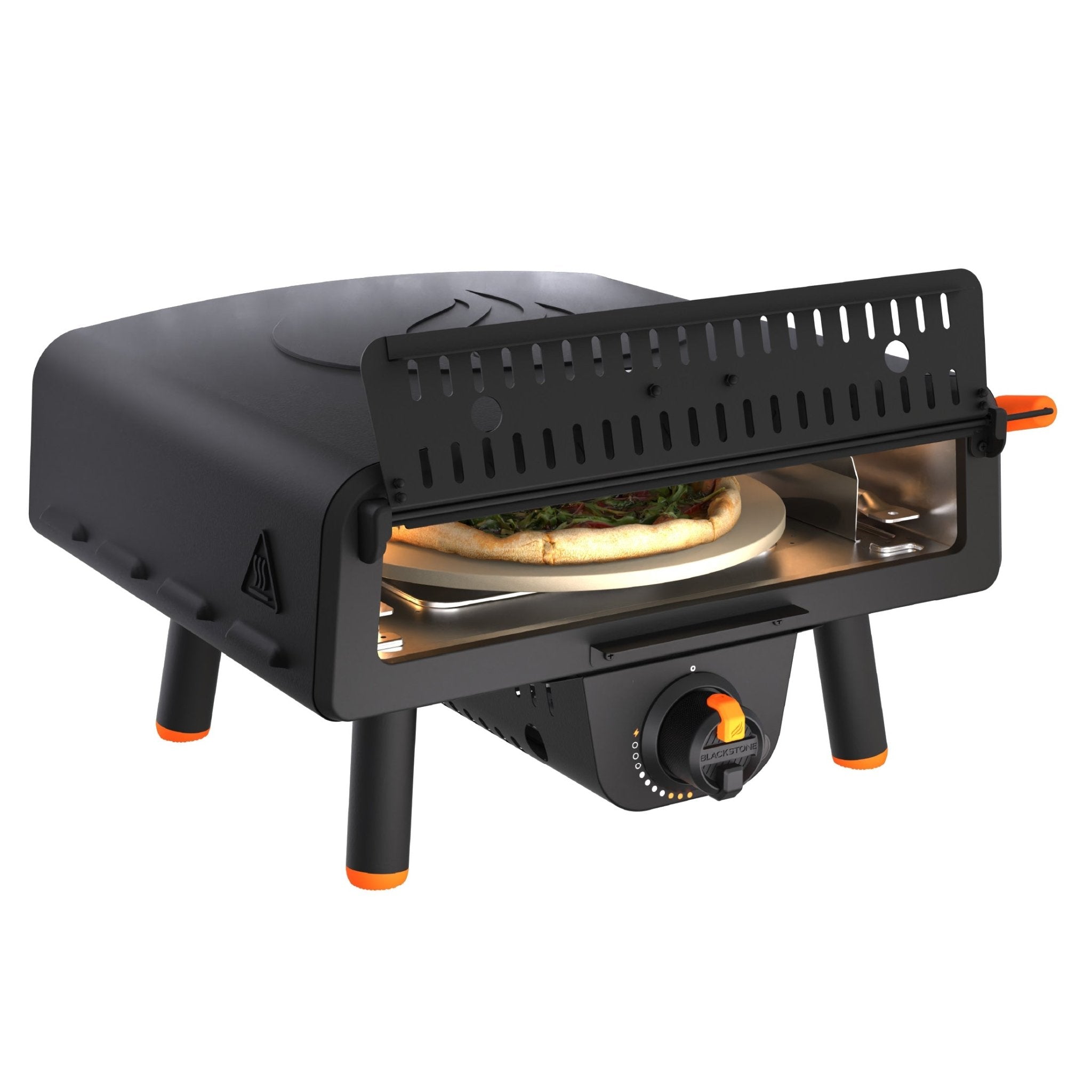
Your needs, this model
Does it fit your priorities?
Does this oven turn the pizza on an included stone instead of requiring hand turning or another accessory?
The manufacturer says the 13-inch cordierite stone is included and rotates. It does not publish a stationary mode or a pizza-size maximum in the accessible description.
Explore this need in the finder →Can I see a temperature gauge at the oven rather than needing a phone feed?
The exact product page lists a built-in temperature gauge. It does not identify the sensor location or describe phone monitoring.
Explore this need in the finder →Does a 13-inch stone guarantee that a 13-inch pizza fits and turns?
No maximum usable pizza diameter is stated. The 13-inch figure is the stone diameter, so a 13-inch pie remains unconfirmed.
Explore this need in the finder →The Blackstone Tabletop Pizza Oven, SKU 2379, is best understood by the two details the manufacturer’s accessible U.S. product page actually makes clear: it has a 13-inch rotating cordierite stone and a built-in temperature gauge. The stone turns the pizza without requiring the cook to rotate it by hand, while the gauge gives a reading at the appliance. Those are useful conveniences, but they do not answer every question that matters before setting up a high-heat oven.
A 13-inch stone does not promise a 13-inch pizza
Blackstone identifies the cooking surface as 13 inches across. That describes the stone, not the largest dough round the chamber will accept. A pizza needs room for its edge to clear the opening and for the turning mechanism to move it without catching. The product page does not give a maximum usable pizza diameter, opening width, or the clearance around a pie while it rotates. If a 13-inch pie is an essential fit, treat the capacity as unconfirmed and ask for a model-specific answer rather than assuming stone diameter and pizza diameter are interchangeable.
The rotating surface is a more decisive feature. For cooks who dislike reaching into a hot chamber to turn a pie, a powered stone can reduce that repetitive step. It does not prove that every pizza will brown evenly: dough thickness, toppings, loading position and heat distribution still matter. The product page does not state a rotation speed, direction, user-selectable mode or what to do if the stone is obstructed. Read the exact instructions before trying to stop, remove or hand-turn the stone.
The built-in gauge is useful, but its measurement is unspecified
A temperature gauge on the oven is convenient because it keeps a basic reading in view without a separate phone. However, the accessible product description does not say whether the gauge reads chamber air, a sensor near the burner, or the stone itself. It gives no accuracy, calibration range or selectable setpoint range. Treat the gauge as an on-appliance indicator—not as a verified stone-temperature probe, a remote monitor or proof that the cooking surface has reached a particular number. If you need a specific baking temperature, get the maker’s instructions for SKU 2379 first.
“Tabletop” can suggest a portable footprint, but Blackstone’s accessible description supplies no overall width, depth, height, assembled weight or required clearance. The marketing adjective “lightweight” is not a lifting specification. Measure the intended counter or stand only after confirming the exact dimensions, support surface and heat clearances in the model instructions. A burner appliance can need space beyond its feet, and the exact setup should not be guessed from a product photograph.
Confirm fuel and location before planning a cook
The exact page identifies the model and its turning stone, but the accessible descriptive text does not set out the fuel source, connection type, burner input, indoor or outdoor approval, hose arrangement or safe clearances. Do not infer a supported fuel or installation from a picture filename, an unrelated warning, or the fact that another Blackstone oven has different controls. The one-year warranty statement is not a substitute for operating instructions. Before use, ask Blackstone for the current manual that names SKU 2379 and check its fuel, ventilation, assembly, lighting, shutoff, cleaning and storage steps.
That uncertainty also changes the finder result. A cook who wants an included rotating stone and an on-unit temperature gauge can keep the 2379 in view. A requirement for a confirmed fuel, indoor/outdoor location, 13-inch pizza, precise setpoint, phone monitoring or measured handling weight should not be treated as satisfied by the available page. Unknown is a real limitation here, not a reason to infer compatibility.
Compared with Blackstone’s E-Series Electric Tabletop 8027B, the 2379 page documents a 13-inch rotating stone and temperature gauge, while the E-Series page documents electric supply, a 14-inch rotating stone, a digital display and timer. Those facts distinguish the public listings, but neither stone diameter proves maximum pizza size, and the exact owner-document bridge for each model remains important. If your setup depends on a known power source, specified clearance or an exact pie size, compare the instructions and published dimensions—not the shared tabletop label—before choosing between them.
The 2379 is a plausible fit for someone attracted to built-in rotation and an on-oven gauge who can verify the installation details before committing. It is a poor match for a buyer who must know the fuel, footprint, safe spacing or exact pizza capacity now. The product page establishes a useful feature pair; it does not establish enough about the operating plan to make those harder requirements disappear.
Key details at a glance
| Fuel versions | Exact 2379 fuel, connection and burner input remain unverified; do not infer fuel from a media filename or a generic page warning. |
|---|---|
| Motorized stone supplied in base package | Yes |
| Monitoring and controls | The exact page describes a built-in temperature gauge at the oven. It does not specify what sensor is measured, a setpoint range, gauge accuracy, phone monitoring or remote startup. |
| Optional rotating setup | The exact U.S. product page says the 13-inch cordierite stone is included and rotates. It does not document a user-selectable stationary mode, speed, direction, or maximum pizza diameter. |
| Space and measurement note | Accessible exact-model product copy does not specify the oven's overall dimensions, assembled weight, working surface requirements or combustible clearances. |
| Stone care | Exact 2379 owner instructions were not retrievable; cleaning, stone handling, lighting, shutoff, ventilation, assembly and storage procedures remain unknown. |
| Cooking modes and limits | The exact U.S. product description does not establish a full settable heat range, maximum temperature, named pizza presets or preheat procedure. |
Use the exact model’s instructions for operating limits, supplied equipment and version differences.
Sources for this assessment
Find a setup for your pizza night.
Choose your fuel, pizza diameter and serving layout, then add turning and monitoring requirements.